
Studying and Working in Ireland in 2026: A Guide for Students

Ireland is no longer simply a picturesque country on the west of Europe; rather, in the last twenty years, it has become one of the best locations for obtaining a top-quality English-language education, a career in technology or finance and starting a new life in a country where the standard of living has frequently ranked among the best ten in the world.
The cities of Dublin, Cork, Galway and Limerick have developed their unique university and business hubs and provide a wide variety of opportunities for individuals with all types of goals from around the globe.
In 2026 there were many changes in the job market after the wave of layoffs resulted from the changes that occurred in the technology sector between 2023 and 2024 as well as digital transformations, however, the job market repaired by 2026 with the emergence of new industries of opportunity, at the same time that the immigration rules were updated and the rental prices remained one of the most significant developments of all of the issues of concern.
In the broader context of the digital economy, one can also observe how online platforms and services reflect this globalisation through various promotional campaigns, such as the 1xbet Promo Code 2026 campaign, illustrating the scale of today’s interconnected digital opportunities.
Nevertheless, Ireland remains a country where international students and young professionals have a real chance not only to survive the first years, but also to put down roots and build something sustainable.
WHY IRELAND - AND WHY NOW
There is seldom one clear-cut answer to the question of where one should study/work internationally. Yet again, when choosing Ireland, there are many reasons why this might be a good option. The first reason regarding language, Ireland is one of only two countries within the Eurozone that uses the English language. As a result, students who do their studies in English will be in the Eurozone and will therefore have opportunities to gain transferable skills and experience and be eligible for a free labour market and receive recognition of qualifications as well as having access to the larger EU labour market.
Secondly, the corporate ecosystem: The European headquarters for many of the world's largest technology companies (Google, Meta, Apple, Microsoft, LinkedIn and Airbnb) are located in Ireland as a result of its stable and long-term tax and regulatory environment that promotes global business.
The small area of the country. This is an advantage that people seldom realise, however, with a smaller area, there will usually be fewer levels of bureaucracy between the individual and any opportunity. The networks of contacts can grow quicker than in other regions and there is a more welcoming atmosphere for newcomers as the Irish are one of the largest diaspora populations in the world and know what it is like to start a new life in a new country.

UNIVERSITIES AND EDUCATION: WHAT THE IRISH SYSTEM OFFERS
Leading universities and their specialisations
The Irish higher education system is small in terms of the number of institutions but high in quality. All leading universities feature in international rankings and have well-developed facilities for international students.
|
University |
City |
Strengths |
QS 2026 ranking |
|
Trinity College Dublin (TCD) |
Dublin |
Humanities, Law, Medicine, Business |
World Top 100 |
|
University College Dublin (UCD) |
Dublin |
Business, engineering, agriculture |
World Top 200 |
|
University College Cork (UCC) |
Cork |
Medicine, Pharmacy, Food Sciences |
World Top 250 |
|
University of Galway |
Galway |
Marine Sciences, Medicine, Law |
World Top 300 |
|
Dublin City University (DCU) |
Dublin |
Communications, IT, Business |
World Top 500 |
|
University of Limerick (UL) |
Limerick |
Engineering, sport, music |
World Top 500 |
|
Technological University Dublin |
Dublin |
Applied Sciences, Design, IT |
National ranking |
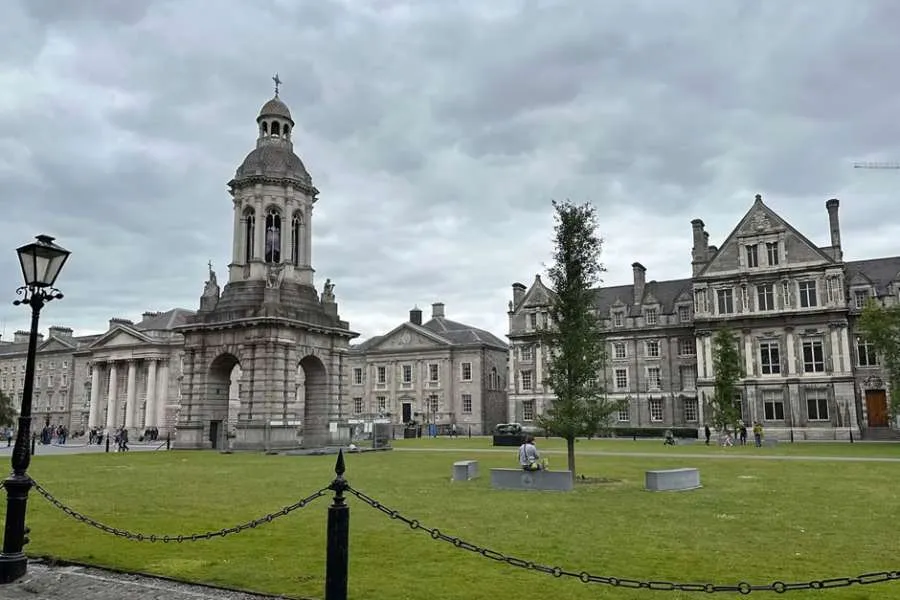
Trinity College is the country’s oldest and most prestigious university, founded in 1592. Its campus in the heart of Dublin is both an architectural landmark and a vibrant academic environment. UCD, on the other hand, is renowned for its strong business programmes and boasts one of Ireland’s largest campuses in Belfield.
What you need to know about admission and studying
The admissions process for international students at Irish universities is not overly complicated, but it does require careful preparation. Most programmes require proof of English language proficiency via IELTS or TOEFL, as well as academic results from your previous place of study.
There are a few practical things worth understanding in advance:
- Tuition fees for students from outside the EU range from €10,000 to €25,000 per year depending on the programme and university - medicine and business are traditionally more expensive.
- A student visa allows you to work up to 20 hours a week during the academic year and up to 40 hours during the holidays.
- Application deadlines are usually in February-March for the autumn semester, and it’s best not to delay - popular programmes fill up quickly.
- Grant schemes do exist, but competition for them is fierce; it is worth researching the Government of Ireland International Education Scholarships and university funds separately.
THE LABOUR MARKET IN 2026: WHERE OPPORTUNITIES LIE AND WHERE THEY DO NOT
2023 and 2024 were painful years for the technology labour market in Ireland. Mass redundancies at Meta, Google and other major companies hit the Dublin market particularly hard - the city was home to a disproportionately large share of these jobs. But by the end of 2025, the situation had stabilised, and in 2026 the market is showing moderate but steady growth.
Demand has concentrated in a few specific areas. Artificial intelligence and machine learning are the clear leaders. Cybersecurity remains a shortage discipline, where experienced candidates can expect highly competitive offers. Cloud infrastructure, DevOps and fintech also maintain steady demand.
Sectors with the highest demand in 2026
Technology is not the only opportunity. The Irish economy is diversified, and there are real opportunities for international professionals in several areas:
- Technology and IT - software development, cybersecurity, cloud services, AI/ML engineering, product management.
- Pharmaceuticals and medical technology - Ireland is one of Europe’s largest manufacturers of pharmaceutical products; demand for engineers, regulatory specialists and scientists remains consistently high.
- Financial services - Dublin remains a major European financial centre post-Brexit; banking, insurance, and asset management.
- Healthcare - nurses, doctors and pharmacists have a fast-track route to obtaining a work permit.
- Construction and engineering - Ireland is experiencing a prolonged construction crisis due to a housing shortage, and qualified construction engineers and architects have good prospects.
- Education and research - postdoctoral positions and university teaching for those pursuing an academic career.
Critical Skills and General Employment Permit
Non-EU nationals require a work permit to work in Ireland. The 2026 system provides for several types, but the two most important are the Critical Skills Employment Permit and the General Employment Permit.
The Critical Skills permit targets shortage occupations with a minimum salary of €32,000 per year (the requirement is higher for certain specialisms). Its advantage is that after two years of work, the holder can apply for a Stamp 4, which grants the right to live and work in Ireland without further permits.
The General Employment Permit has a broader scope but requires confirmation that the employer has attempted to recruit a candidate from among EU citizens - the so-called Labour Market Needs Test. It is more bureaucratically complex, but for many professions, it is the only available route.
COST OF LIVING: REAL FIGURES AND REAL CHALLENGES
Dublin: expensive, but not hopeless
Dublin ranks among the top 10 most expensive cities in Europe in terms of rent - and this is a fact you need to take into account from the outset. The average rent for a one-bedroom flat in the city in 2026 ranges from €1,800 to €2,400 per month. A room in a shared house costs between €900 and €1,400.
But there are nuances. Firstly, Dublin is not a monolith. The difference between the central districts and the suburbs is significant, and public transport (Luas, DART, Dublin Bus) allows you to live further from the centre without significant inconvenience. Secondly, Cork, Galway and Limerick are noticeably cheaper - and for students and young professionals who aren’t tied to a Dublin office, these cities may be a much wiser choice.
Here is an approximate monthly budget for an international student or young professional in Dublin:
- Room rent - €950 to €1,400
- Food and groceries - €300–450 (cooking at home is much cheaper)
- Transport - €100-140 (monthly Leap Card with a student discount)
- Utilities - usually included in the rent or €80–120
- Mobile phone - €15–30 per month
- Entertainment and social life - €150–300 depending on lifestyle
- Total - €1,700 to €2,500 per month
DAILY LIFE: WHAT NEWCOMERS CAN ACTUALLY EXPECT
Most international students and professionals note the same thing: the Irish are genuinely friendly, and this is not a tourist myth. Initial adaptation is usually easier than in many other countries - there is no language barrier, people are willing to help, and the university and work environments are generally consciously inclusive.
It is more difficult to build deeper social connections outside the work or study environment. Irish social culture is largely built around existing networks - schools, families, and neighbourhoods. Newcomers need to actively seek out entry points: student clubs, sports clubs, volunteering, and pubs with regular events. The climate is a separate issue that you need to be mentally prepared for. Ireland is rainy, grey and windy for most of the year, and for people used to a sunny climate, the first Irish winter can be tough.
In Ireland’s everyday social life, international students and young professionals often combine study or work with leisure activities, including spending time in pubs and engaging in online entertainment, such as gaming platforms and promotional offers like the 1xbet Promo Code 2026, reflecting how digital leisure has become part of modern social habits.
IRELAND AFTER GRADUATION: STAY OR GO
One of the key questions for every international student is what to do after graduation, and Ireland offers several legal ways to stay. A third-level qualification entitles you to a so-called Graduate Visa - permission to remain in the country after completing your studies to look for work. For master’s and PhD students, this period is 24 months, while for undergraduates it is 12 months, making it a widely used route for transitioning from student status to employment. For those who already have a job and wish to stay long-term, the path to permanent residence - Stamp 4 or long-term residence - opens up after five years of legal residence in the country, followed by eligibility for Irish citizenship after eight years, which is one of the most sought-after in Europe and grants full access to the EU labour market.
Ireland in 2026 is a country of real challenges and real opportunities. It is not perfect: housing prices, queues at government offices and a grey climate are all part of the package. But for those who arrive with clear goals, an openness to adapt and a willingness to put in the effort, it offers an environment where that effort truly pays off.
Share: