
Scientific breakthrough could predict volcanic eruptions in the Canary Islands two days in advance
A new scientific method developed by Spanish researchers could make it possible to anticipate volcanic eruptions in urban areas up to two days before they occur, dramatically improving emergency planning and public safety in volcanic regions such as the Canary Islands.
The pioneering methodology has been developed by the Instituto Geológico y Minero de España (IGME-CSIC), the Instituto Geográfico Nacional (IGN) and the Universidad de Valencia. It has now been selected by the United Nations Office for Disaster Risk Reduction as a tool with global potential to improve how authorities prepare for and manage volcanic emergencies.
According to researchers, magma does not rise randomly through the Earth’s crust. Instead, it follows a recognisable pattern over time, described by scientists as a form of “memory”. This memory generates a series of persistent and stable seismic movements that can be detected and analysed. The findings have been published in the scientific journal Scientific Reports, as confirmed by the Consejo Superior de Investigaciones Científicas (CSIC).
When this magma “memory” changes, however, the seismic pattern also shifts. Scientists observe a new and irregular sequence of earthquakes, different from those previously recorded, revealing that the magma has stopped stagnating or moving slowly and has begun an unstoppable ascent towards the surface. This sudden change is what researchers describe as a point of no return before an eruption.
The new methodology is considered unique worldwide and uses advanced algorithms to detect this transition in magma behaviour. By identifying the moment when the long-term memory of the magma changes, scientists can pinpoint a reliable signal around two days before an eruption takes place.
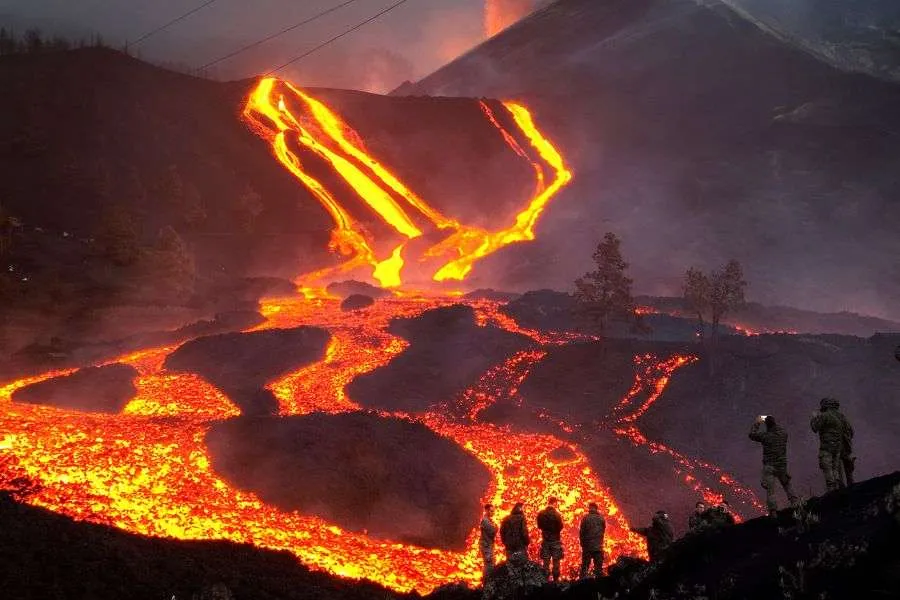
Data gathered during the 2021 eruption on La Palma has played a key role in the development of the technique. That eruption, at the Tajogaite volcano in the Cumbre Vieja area, affected more than 8,000 people and destroyed around 1,200 homes.
“This innovative approach opens up new possibilities for early-warning systems based on the real-time analysis of volcanic earthquake sequences,” explained Raúl Pérez, a researcher at IGME-CSIC. “It can be applied to existing seismic monitoring networks during a volcano-tectonic crisis.”
Crucially, the tool does not only help predict the onset of an eruption. The algorithm can also indicate when a volcano is beginning to lose eruptive strength. When the magma memory indicator stabilises, scientists detect what they call an asymptotic trend, a sign that the volcanic engine driving the eruption is running out of energy.
This ability to anticipate the possible end of an eruption is vital for emergency management, as it allows authorities to begin planning the safe return of residents and the start of reconstruction efforts.
Due to its potential impact on future volcanic crisis management, the methodology has been included by the UN Office for Disaster Risk Reduction on PreventionWeb, its global knowledge-sharing platform for emergency and disaster management. The aim is to ensure the method is widely shared among institutions responsible for handling natural disasters worldwide.
During the 2021 eruption on La Palma, numerous CSIC researchers were deployed on the ground to provide scientific monitoring and advice. The extensive data collected at that time formed the foundation for the new technique, which is based on statistical algorithms applied to the earthquakes recorded throughout the eruption.
“Our work combines mathematical modelling of earthquakes linked to magma rising from depths of around nine kilometres with exhaustive fieldwork carried out day by day and hour by hour during the La Palma eruption,” Pérez added. “This allowed us to identify signals linked to changes in eruptive dynamics and to determine that the eruption lasted 86 days due to five deep magma injections.”
For volcanic regions with populated areas, including parts of the Canary Islands, the researchers believe this breakthrough could be a major step forward in protecting lives and reducing the impact of future eruptions on communities.
Share: