
Triple solar eclipse set to light up Canary Islands skies
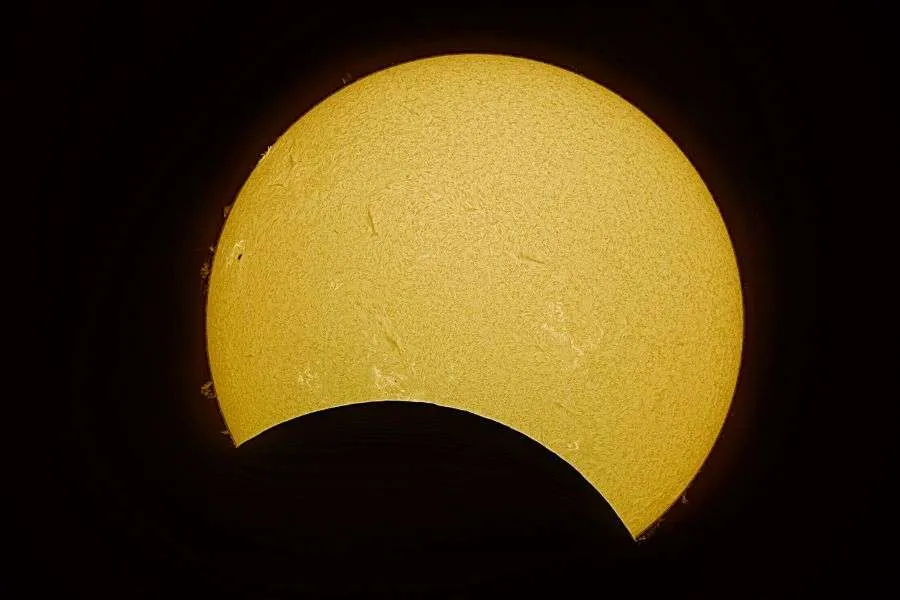
Residents and visitors in the Canary Islands are being encouraged to prepare for a rare astronomical treat, as three solar eclipses will be visible from the archipelago between 2026 and 2028.
Experts from the Instituto de Astrofísica de Canarias (IAC) say the unusual sequence of eclipses is already generating excitement among astronomers, science communicators and skywatching enthusiasts.
The events will take place on 12th August 2026, 2nd August 2027, and 26th January 2028, offering several opportunities to witness one of nature’s most fascinating celestial displays.
What happens during a solar eclipse
A solar eclipse occurs when the Moon passes between the Earth and the Sun, partially or completely blocking the Sun from view in certain parts of the world.
For observers in Spain and the Canary Islands, the upcoming eclipses will largely occur near sunrise or sunset, meaning the Sun will appear very low on the horizon when the phenomenon begins or ends.
According to science communicator Alfredo Rafael Rosenberg González, writing on the IAC blog earlier this week, this makes careful planning essential if you want to see the event clearly.
Mountains, hills, buildings or even small changes in the landscape can block the view when the Sun is so low, particularly in places with rugged terrain such as the Canary Islands.
Planning ahead is key
Although solar eclipses often attract large crowds of eager viewers, experts warn that it is not something to leave to chance.
Several factors can determine whether the eclipse will actually be visible from a chosen location. These include the position of the Sun in the sky during the event, the surrounding landscape, potential obstacles such as buildings or mountains, and, of course, the weather conditions on the day.
Because the upcoming eclipses will happen close to sunrise or sunset, local geography becomes especially important. Even relatively small hills can hide the Sun completely if it sits just above the horizon.
For that reason, astronomers recommend using digital simulation tools to plan the best viewing spots well in advance.
Digital tools can help find the best viewing spots
Several free online platforms allow users to simulate the position of the Sun and shadows from any location on Earth.
One example is ShadeMap, which shows how shadows move across terrain throughout the day depending on the Sun’s position. This can help determine whether a particular viewing point might fall into shadow at the key moment of the eclipse.
The 2026 eclipse: what to expect
One of the most anticipated events will take place on 12th August 2026.
From areas such as Santa Cruz de Tenerife, the eclipse is expected to last almost two hours.
It is forecast to begin at around 18:58, continuing until sunset at approximately 20:45, with the maximum eclipse occurring at about 19:53.
However, visibility will vary across the islands. Because the Sun will be so low in the sky at that time, some areas may struggle to see the eclipse if the view is blocked by surrounding mountains.
Simulating the sky with Stellarium
Another popular tool used by both professionals and amateur astronomers is Stellarium, a free programme that recreates the night sky from any point on Earth at a chosen date and time.
The software allows users to visualise the exact position of the Sun, Moon and planets, track their movements across the sky throughout the day, and preview what the sky will look like at specific moments.
Thanks to these features, Stellarium is widely used for both astronomy planning and educational activities, allowing users to predict with remarkable accuracy how the sky will appear from a given location.
Analysing the horizon with PeakFinder
For even more precise planning, Stellarium can be combined with PeakFinder, a web tool that creates a detailed horizon profile from any selected point on the map.
By analysing surrounding mountains and geographical features, PeakFinder helps determine whether the Sun or other celestial objects may be hidden behind the landscape.
Using the tool is simple: users enter a location or its coordinates, select the exact viewpoint on the map, and the programme automatically generates a horizon profile showing the surrounding terrain.
With three eclipses on the horizon over the next few years, astronomers say the Canary Islands could become an ideal destination for eclipse watchers, offering spectacular views for those who plan their viewing spots carefully.
Share: