

Scientists and fishermen join forces in the Canaries to track Thresher Sharks
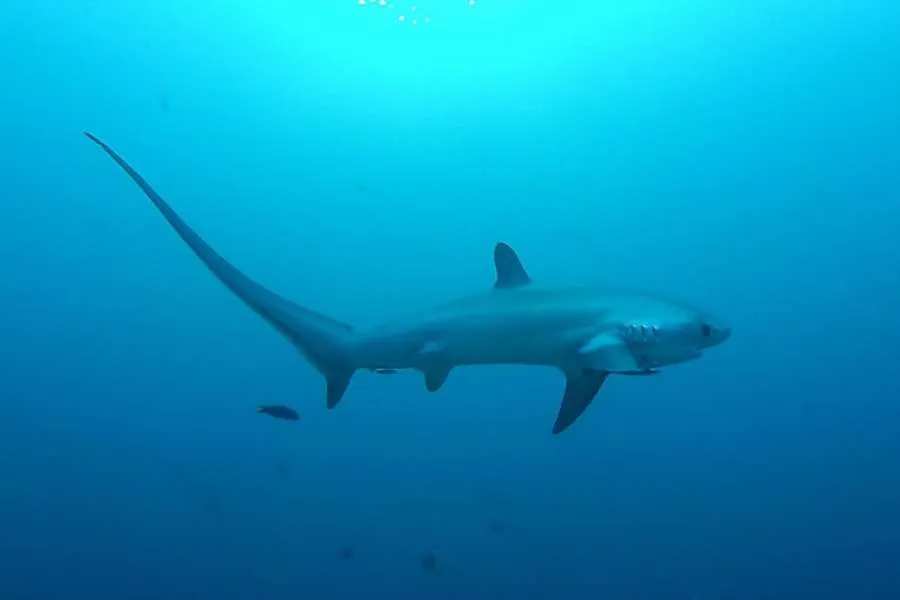
A team of marine scientists in the Canary Islands is preparing for what they describe as “an adventure”, heading out to sea with local fishermen to track one of the Atlantic’s most elusive predators: the thresher shark.
Researchers from the Universidad de Las Palmas de Gran Canaria (ULPGC), working within the Ecoaqua Institute, are teaming up with experienced Canarian fishermen to capture, measure and satellite-tag these powerful deep-water sharks for the very first time in the region.
The project, led by David Jiménez Alvarado of the Biocon research group, forms part of the BioMAR elasmobranch programme under CanBio. Its aim is simple in theory but complex in practice: find out where these sharks go, how they use Canarian waters, and whether they remain in the islands year-round or cross vast stretches of the Atlantic.
A Rare and Powerful Predator
The thresher shark is not often seen. It inhabits deeper offshore waters, far from beaches and typical tourist areas. However, fishermen — particularly in southern Gran Canaria — report regular encounters. “We know they’re here,” Jiménez explains. “But we have almost no information about their movements.”
What makes the thresher shark especially challenging is its enormous tail, which can be as long as its body and acts like a muscular whip. Adult specimens can exceed 2.5 metres in length and weigh around 200 kilos, meaning strict safety protocols are essential during handling.
When one is accidentally caught, the plan is to secure it carefully alongside the boat, keep water flowing over its gills for oxygen, cover its eyes to reduce stress, and immobilise the tail before attaching a satellite transmitter.
Each tag costs around €5,000, limiting the team’s initial goal to one shark, although they hope to tag up to three.
Military-Style Precision at Sea
The Ecoaqua team is no stranger to working with large marine species. They have previously tagged hammerhead sharks, blue sharks and shortfin makos, and have extensive experience with angel sharks and stingrays.
“We operate almost like a military unit,” Jiménez says. “Everyone has a specific role and strict timing to minimise impact on the animal.” International shark-tagging experts are also advising the project to ensure the highest safety and scientific standards.
Fieldwork is expected to begin between late 2026 and early 2027, the time of year fishermen say threshers are most likely to be encountered.
Mapping the Unknown
The satellite tags will provide crucial data on migration routes, habitat use, and differences between males and females, information that is currently a complete mystery. “We genuinely don’t know their routes,” Jiménez admits. “And that’s exactly what makes it exciting.”
Understanding shark movements is increasingly important in the face of climate change and shifting ocean conditions.
Clearing Up Confusion Over Local Species
The collaboration will also help clarify identification of the seven different smoothhound shark species found in the Canary Islands. According to researchers, there is widespread confusion, with the same species often known by different local names depending on the island.
The project has already deployed a network of underwater acoustic receivers across the archipelago to track tagged animals. Pending final ministerial permits, the team also plans to tag 30 smoothhounds in the near future.
Building on Years of Shark Research
Over the past eight years, the CanBio programme — including the Angel Shark Project and Rays of Paradise Project — has tagged more than 100 angel sharks and a similar number of stingrays.
Research has revealed that female angel sharks tend to remain in shallower coastal waters, while males venture into deeper areas. Temperature differences also affect them in distinct ways, key data as Atlantic waters gradually warm.
Tracking has confirmed that angel sharks remain year-round in certain areas, including the marine reserve of La Graciosa, even when rarely seen.
Stingrays, once believed to visit certain beaches only in summer, have also been shown to return to the same coastal areas year after year.
Now, scientists and fishermen alike are turning their attention to a new shadow beneath the Atlantic blue.
Whether the mission succeeds remains to be seen. “But one thing’s certain,” Jiménez says with a smile. “It will be an adventure.”
Share: