
When is a parked car legally considered abandoned in the Canary Islands?
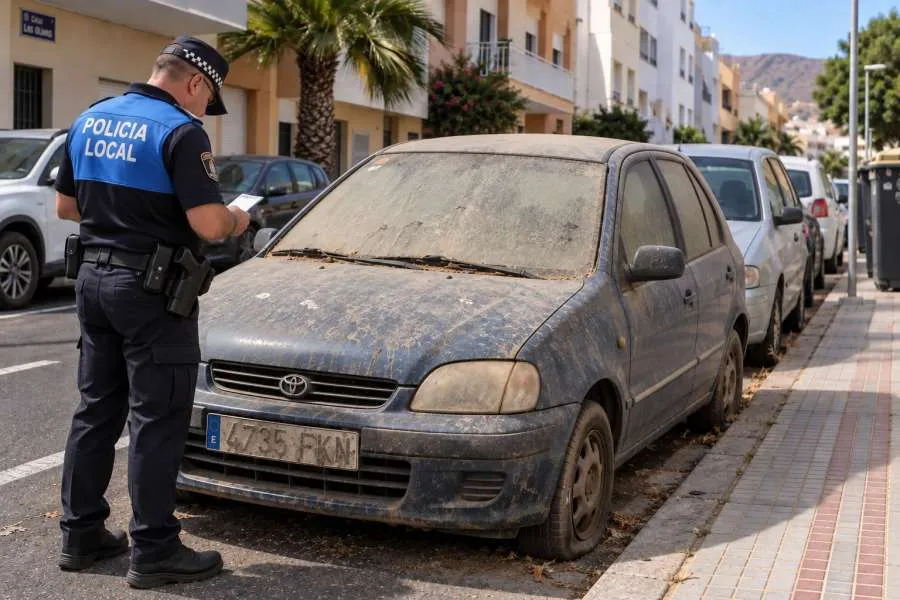
A car that has been parked for weeks may look abandoned, particularly if it is covered in dirt or appears not to have moved, but that does not necessarily mean the authorities can simply tow it away.
The issue regularly causes frustration in the Canary Islands, where parking spaces can already be difficult to find in busy towns and tourist areas. However, there are specific legal conditions governing when a vehicle can be treated as abandoned, and simply leaving a car in the same place for several days is not enough.
Under Spain's Traffic Law, which applies throughout the Canary Islands, the authorities can order a vehicle to be taken to an authorised treatment centre for destruction and decontamination in certain circumstances.
One of the clearest situations is when a vehicle has remained parked in the same place for more than one month and either has damage that makes it impossible to move under its own power or is missing its registration plates.
This distinction is important because a vehicle does not automatically become legally abandoned simply because it looks neglected.
A dirty windscreen, dust-covered bodywork or flat-looking tyres may lead neighbours to suspect that a car has been left behind, but appearance alone is not sufficient.
Similarly, Santa Cruz Local Police recently clarified that issues such as an expired ITV or lack of insurance do not, by themselves, establish that a vehicle has been abandoned.
Councils have to follow a procedure
Local authorities and police must carry out checks before deciding what action should be taken.
Where a suspected abandoned vehicle is reported, officers can inspect it, establish its condition and attempt to identify its registered owner.
The national legislation also covers vehicles that have already been removed from the road.
A vehicle may ultimately be sent to an authorised centre when more than two months have passed since it was immobilised or removed from the public highway and placed in an official compound, where the owner has not made representations.
Before ordering its transfer for destruction, the authorities must contact the registered owner and warn them to remove the vehicle within one month. If the owner fails to do so, the authorities can then proceed with it being dismantled or crushed.
It can be removed sooner in other circumstances
None of this means councils must leave a dangerous or obstructing vehicle on the road for a month.
The Traffic Law separately allows the authority responsible for traffic management to remove vehicles when they constitute a danger, seriously disrupt vehicle or pedestrian traffic, damage public services or property, or obstruct or create a hazard for traffic.
There are also specific provisions allowing vehicles to be removed from disabled parking spaces, restricted lanes and loading areas in certain circumstances.
So the rules governing an abandoned vehicle should not be confused with the wider powers available to police and councils to tow illegally parked, dangerous or obstructive vehicles.
Rules can differ between Canary Islands municipalities
There is another important point for motorists across Tenerife, Gran Canaria, Lanzarote, Fuerteventura and the other islands.
While the national Traffic Law establishes the underlying rules, individual councils can also have their own parking and traffic ordinances covering matters such as how long a vehicle may remain continuously parked in the same location.
For example, Santa Cruz de Tenerife has a municipal rule allowing action to begin when a vehicle has remained in the same place for more than ten days. Local Police have stressed, however, that this does not mean the car automatically becomes an abandoned vehicle after ten days.
Other municipalities may have different local provisions.
Anyone concerned about a vehicle that appears to have been abandoned should therefore report it to their local Ayuntamiento or Local Police rather than assuming it can automatically be removed after a particular number of days.
The authorities can then check the vehicle, identify its owner where possible and determine whether the legal conditions for further action have been met.
Share: