
Calls grow to restrict foreign property buyers in the Canary Islands
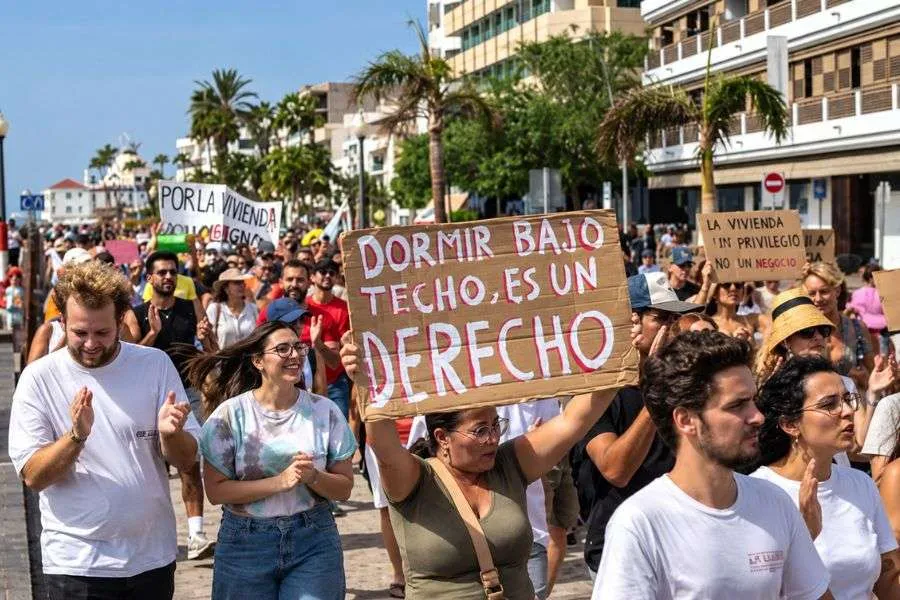
Housing campaigners in the Canary Islands are stepping up demands for action over the housing crisis, including tougher restrictions on property purchases by non-residents, as activists and unions also consider the possibility of a general strike.
The latest proposals come after thousands of people took part in housing demonstrations across the archipelago at the weekend, including major protests in Santa Cruz de Tenerife and Las Palmas de Gran Canaria.
Campaign group Canarias Tiene un Límite says measures currently being discussed to restrict property purchases by non-residents do not go far enough.
The group wants prospective buyers to demonstrate between five and ten years of legal, effective and continuous residence in the Canary Islands before being permitted to purchase residential property.
However, this is currently a campaign proposal and not a change in the law. Foreign residents and overseas buyers remain able to purchase property in the Canary Islands under existing regulations.
Calls for restrictions on non-resident buyers
The proposal comes amid efforts by the Canary Islands Government to secure support at European level for measures allowing restrictions on residential property purchases by non-residents.
Supporters argue that the islands face exceptional housing pressures because of their limited territory, rapidly rising property prices and strong demand from investors and overseas buyers.
Any new restrictions would, however, have to comply with Spanish and European Union law, including rules governing the free movement of capital.
Canarias Tiene un Límite is pushing for residency to become a key requirement, arguing that housing should primarily serve people who have established their lives in the islands.
The debate is particularly important for the Canary Islands' substantial international community and overseas property market.
Campaigners consider general strike
At the same time, housing organisations are considering how to escalate their campaign following Saturday's demonstrations.
Tenant groups and activists in Tenerife and Gran Canaria are now turning their attention towards further mobilisation, including the possibility of a general strike over housing.
Trade unions CCOO and UGT are also considering the issue.
No general strike has currently been called, and there is no confirmed date for industrial action.
In Gran Canaria, activists are also redirecting their efforts towards forthcoming evictions and further campaigning as the protest camp there comes to an end.
Thousands joined weekend protests
As Canarian Weekly previously reported, thousands took part in demonstrations across the islands on Saturday demanding measures to make housing more affordable.
Official estimates put attendance at around 3,500 in Las Palmas de Gran Canaria and 2,000 in Santa Cruz de Tenerife, although organisers in Tenerife claimed considerably more people participated.
Smaller demonstrations were also held in Arrecife and Puerto del Rosario.
Campaigners are demanding more public housing, measures to control rental costs and stronger action against property speculation.
Housing affordability has become one of the Canary Islands' most contentious issues, particularly in areas experiencing strong population growth, investment and tourism-related demand.
Campaigners also argue that holiday rentals have contributed to pressure on the residential market, although the shortage has broader causes including limited construction, insufficient public housing and increasing demand.
The latest developments indicate that the weekend demonstrations are unlikely to be the end of the campaign, with pressure now shifting towards both property ownership restrictions and possible industrial action.
Share: