
Scientists Identify Major Magma Accumulation Beneath Tenerife
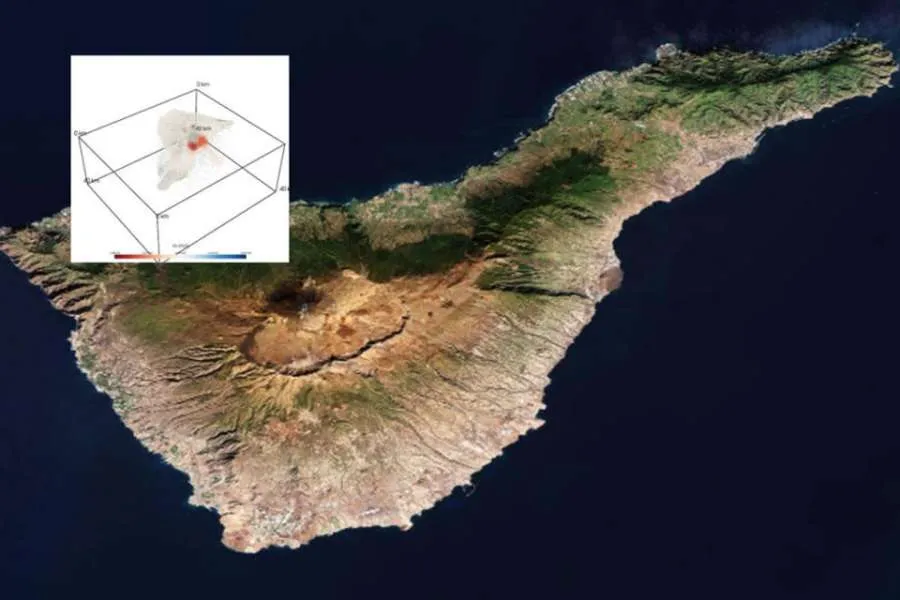
Scientists have identified a significant accumulation of magma deep beneath western Tenerife which could be connected to the unusual seismic activity recorded on the island since 2016, giving them a better understanding of how and why the activity is happening.
The discovery comes from new research led by the Canary Islands Volcanology Institute (INVOLCAN) and published in Scientific Reports, part of the Nature portfolio.
Researchers have produced a detailed three-dimensional image of the geological structure beneath Tenerife for the first time, identifying several areas deep below the island where seismic waves travel unusually slowly.
According to the researchers, these anomalies could indicate areas of very high temperatures and changes in the physical composition of the rocks, potentially associated with magma originating in the upper mantle.
What's beneath Tenerife?
One of the study's main findings is the identification of a relatively rigid layer of old oceanic crust around 10 kilometres thick beneath the island.
Below this layer, however, the structure becomes considerably more complex.
Scientists identified four major low-seismic-velocity anomalies beneath different parts of Tenerife, extending approximately 10 to 30 kilometres below the surface.
Lower seismic-wave velocities can indicate particularly hot rock and, under certain conditions, the presence of partially molten material.
The most significant discovery was beneath western Tenerife, where researchers detected what they describe as "exceptionally low" velocities of S-waves.
When these measurements were combined with thermodynamic modelling, the results indicated that the anomaly could contain a significant proportion of molten material — in other words, magma.
Scientists believe this could represent a particularly magma-rich area within the upper mantle beneath the island.
3D images developed by Involcan showing the magma beneath Teide
Possible link to Tenerife's earthquakes
The research is particularly significant because scientists have found a geographical relationship between these deep anomalies and seismic activity recorded across Tenerife in recent years.
A substantial proportion of earthquakes detected beneath the island have occurred either above or around the edges of the main low-velocity anomaly.
Researchers say this distribution could be connected to the accumulation and movement of magma at considerable depth.
As magma rises from the upper mantle towards shallower levels, the reduction in pressure allows gases dissolved within it to separate. At these depths, INVOLCAN says these gases consist mainly of carbon dioxide (CO₂).
These gases and other magmatic fluids can then migrate upwards and interact with Tenerife's hydrothermal system.
Scientists believe this process could help explain some of the seismic activity detected on the island, including hybrid and low-frequency earthquakes.
Improving understanding of Tenerife's volcanic system
The findings don't mean that an eruption is imminent. Instead, the study provides scientists with a clearer picture of the processes taking place tens of kilometres beneath Tenerife and how they may be connected with earthquakes and volcanic gas emissions detected at the surface.
INVOLCAN says the research significantly improves understanding of the deep structure of Tenerife's magmatic system, particularly the relationship between magma stored in the upper mantle and activity detected closer to the surface.
The accumulation identified beneath western Tenerife may be associated with a process known as magmatic underplating, where magma rising from the mantle gradually accumulates at the base of the oceanic crust rather than travelling directly towards the surface.
Understanding these deep magma-storage areas is important for scientists monitoring Tenerife because changes in seismicity, gas emissions and other indicators can provide valuable information about how the island's volcanic system is behaving.
The research was led by Víctor Ortega Ramos, an INVOLCAN researcher and doctoral student at the Complutense University of Madrid.
The project involved collaboration between INVOLCAN, the Complutense University of Madrid, Tenerife's Institute of Technology and Renewable Energies (ITER), the University of Geneva in Switzerland, and Portugal's Institute for Research in Volcanology and Risk Assessment (IVAR).
Share: